
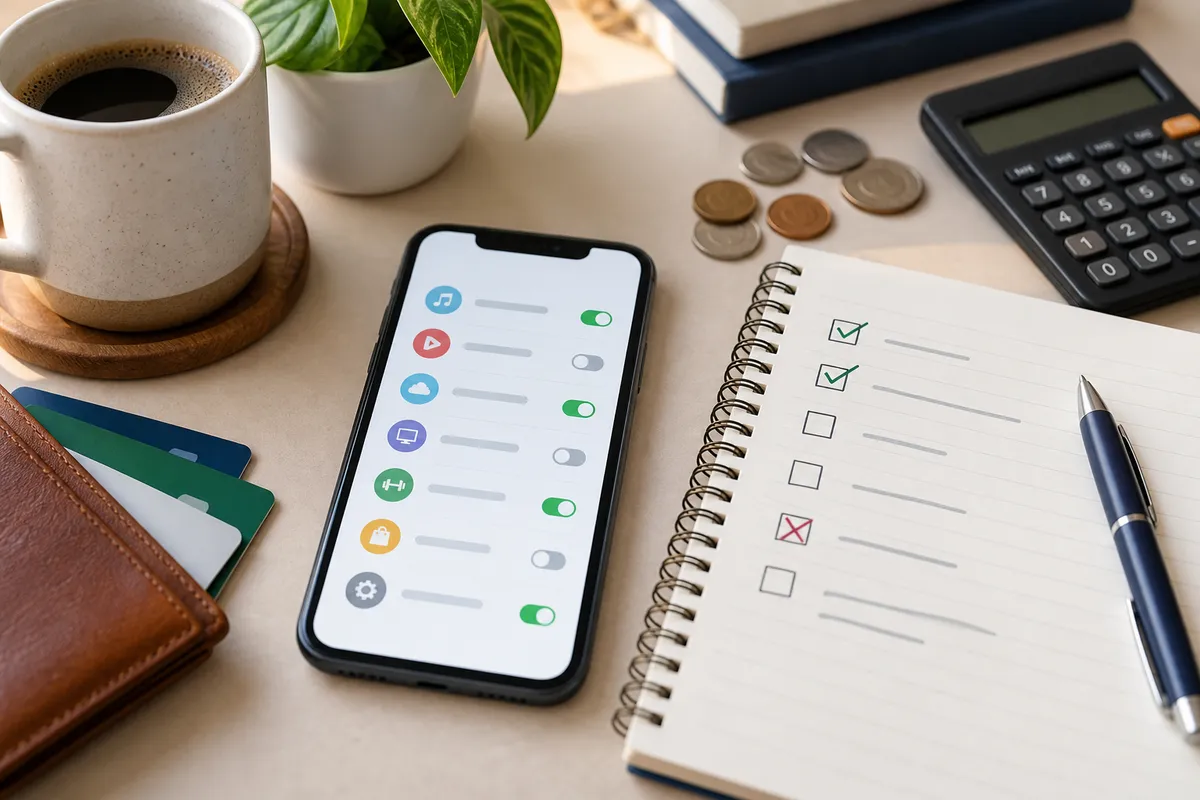
Subscriptions rarely wreck a budget one charge at a time. The leak appears when small monthly fees, annual renewals, free trials, app purchases, memberships, and duplicate services accumulate across several cards and accounts. A subscription audit makes those commitments visible so you can decide what to keep, pause, rotate, downgrade, or cancel.
This article provides general educational information only. It is not individualized financial, legal, tax, credit, benefits, retirement, or investment advice. Contract terms, cancellation rights, refund policies, account protections, and household needs vary. Review the current agreement and official guidance that apply to your situation, and consult a qualified professional when needed.
Start With a Complete Inventory
Do not rely on memory. Review at least the last 12 months of transactions from every place a recurring charge could appear:
- Checking and credit-card statements
- Digital wallets and payment services
- Mobile-device and app-store subscription pages
- Email receipts and renewal notices
- Retail memberships and delivery programs
- Streaming, software, cloud storage, gaming, news, fitness, meal, and learning accounts
- Work, military, veteran, school, or professional memberships paid personally
A full year matters because annual renewals can disappear between monthly budget reviews. Search transaction histories for words such as renewal, membership, premium, plus, pro, cloud, storage, media, digital, annual, and recurring. Merchant names on statements may differ from the brand you recognize, so investigate an unfamiliar charge through the card issuer's merchant details or the company's official website rather than clicking a link in an unexpected message.
Record each item in one list with the merchant, service, payment account, amount, billing frequency, next renewal date, cancellation method, and household user. Include free trials and promotional prices, along with the date and price that will apply when the promotion ends.
Convert Every Charge to an Annual Cost
A monthly price can feel harmless because it competes with other spending one billing cycle at a time. Annualizing puts every service on the same scale:
- Weekly charge × 52
- Monthly charge × 12
- Quarterly charge × 4
- Annual charge as listed
A $9.99 monthly service is about $119.88 per year before taxes or price changes. Three similar charges are about $359.64. Annual cost does not automatically make a service wasteful, but it gives you a fair number to compare with its actual use and value.
Also calculate the total recurring cost per month and year. Keep necessary insurance, utilities, debt payments, charitable gifts, and other recurring obligations visible, but distinguish them from optional subscriptions. Stopping a payment method is not necessarily the same as canceling a contract or eliminating an amount you legally owe.
Use Four Decisions: Keep, Pause, Rotate, or Cancel
Keep
Keep a service when the household uses it consistently, the benefit is worth the current price, and it fits the plan after essentials and savings. Record why it stays and set a review date. A deliberate keep is different from ignoring the charge.
Pause
Pause when the service has seasonal value or life is temporarily too busy to use it. Confirm whether pausing preserves data, playlists, credits, pricing, or membership status, and whether billing restarts automatically. Put the restart date and expected charge on the calendar.
Rotate
Rotate overlapping entertainment, fitness, learning, or meal services instead of paying for all of them continuously. Keep one active, finish what you intended to use, cancel or pause it, and then activate the next. Rotation works only when you track restart and renewal dates.
Cancel or Downgrade
Cancel services that are unused, duplicated, difficult to explain, or worth less than their annual cost. Before canceling, check for a lower tier, family or household option, eligible military or veteran discount, employer benefit, library access, or another legitimate replacement. Compare the full terms, not just a promotional price, and do not share accounts in a way that violates service terms.
A Simple Value Test
For each optional subscription, answer five questions:
- Who used it during the last 30 or 90 days?
- What problem does it solve or enjoyment does it provide?
- Is another paid service doing the same job?
- What is the annual cost at the current or post-promotion price?
- Would you knowingly buy it again today at that price?
If the last answer is no, move it to the cancel, pause, or downgrade list. Avoid judging every subscription only by cost per use. A rarely used safety, accessibility, backup, or professional tool may still be valuable. The point is to make the tradeoff explicit.
Cancel Carefully and Keep Evidence
The Federal Trade Commission advises consumers to follow the company's cancellation instructions, keep a copy of the request, save notes about conversations, and monitor bank or card statements afterward. Use the company's official app, website, or a verified customer-service channel. Be cautious with unexpected renewal emails or texts that demand immediate action or payment information; scammers use fake subscription notices to collect money or account details.
Before submitting a cancellation:
- Check the renewal deadline, notice requirement, cancellation fee, refund policy, and effect on stored data or credits.
- Export records, photos, documents, receipts, or other information you are entitled to keep.
- Take a screenshot or save the confirmation page, email, chat transcript, or reference number.
- Write down the cancellation date and the last authorized charge.
- Set a reminder to inspect the next two statements.
Do not assume that deleting an app cancels its subscription. Billing may be controlled by the service, an app store, a payment platform, or another account. Follow the cancellation route shown in the agreement or account settings and confirm the final status.
If Charges Continue
If a company charges a credit or debit card after you canceled, contact the company and the card issuer promptly, keep your evidence, and follow the issuer's dispute process. Deadlines and protections can differ by payment type and circumstance.
For automatic debits from a bank or credit-union account, the Consumer Financial Protection Bureau explains that you can revoke a company's authorization and notify the financial institution. A stop-payment order may also be available and may carry a fee. Revoking an automatic debit does not by itself cancel an underlying contract or erase an amount still owed, so address both the payment authorization and the service agreement.
Report unauthorized transfers quickly. The timing of your notice can affect available protections. If a cancellation problem or unauthorized subscription is not resolved, the FTC accepts reports at ReportFraud.ftc.gov, and your state attorney general or another appropriate regulator may also provide guidance.
Redirect the Savings Before It Disappears
A canceled charge creates room in the budget only if the money receives a new job. Add the confirmed monthly savings to one priority, such as:
- A checking-account cushion
- An emergency fund
- A sinking fund for insurance, car repairs, holidays, or moves
- An extra debt payment
- A planned household goal
Wait until cancellation is confirmed before treating the amount as available. If an annual service was prepaid, the monthly cash flow may not change immediately even though the next renewal has been prevented.
Build a 15-Minute Monthly Review
Once the initial audit is complete, prevent the list from rebuilding:
- Review all card and checking transactions once a month.
- Compare recurring charges with the subscription list.
- Update prices, renewal dates, and household users.
- Cancel trials before their deadlines when you do not want to continue.
- Review annual renewals at least 30 days before the charge when possible.
- Recalculate the monthly and annual totals.
Use calendar reminders rather than relying only on a merchant's renewal notice. When you start a trial, immediately record the end date, expected conversion price, and cancellation steps. Consider using one payment account for optional subscriptions if that makes monitoring easier, while still following each service's terms and keeping the account secure.
Subscription Audit Worksheet
For each item, record:
- Service and merchant name:
- Payment account:
- Current charge and frequency:
- Annualized cost:
- Promotion end date or next renewal:
- Last used and used by whom:
- Decision: keep, pause, rotate, downgrade, or cancel
- Action date and confirmation number:
- Follow-up statement date:
The Bottom Line
A subscription audit is not a contest to eliminate every convenience. It is a way to make recurring spending compete openly for a place in the budget. Find every charge, translate it into an annual cost, decide deliberately, document cancellations, and monitor the account afterward.
Keep what genuinely serves the household. Pause or rotate what is useful only sometimes. Cancel what no longer earns its place, then direct the savings toward a goal you chose on purpose.
Sources and Official Starting Points
- Federal Trade Commission: Free Trials, Auto-Renewals, and Negative Option Subscriptions
- Consumer Financial Protection Bureau: How to Stop Automatic Payments From a Bank Account
- Consumer Financial Protection Bureau: Bank Account Key Terms
- Consumer.gov: Making a Budget
- Federal Trade Commission: ReportFraud.ftc.gov
Disclaimer: Dollar Feeder provides general educational information only. This article is not financial, investment, tax, legal, benefits, credit, retirement, or individualized planning advice and does not create a professional-client relationship. Laws, deadlines, account terms, prices, and consumer protections can change or apply differently. Confirm decisions with current official sources, the service agreement, the relevant financial institution, and qualified professionals.
~Veteran Owned and Operated~